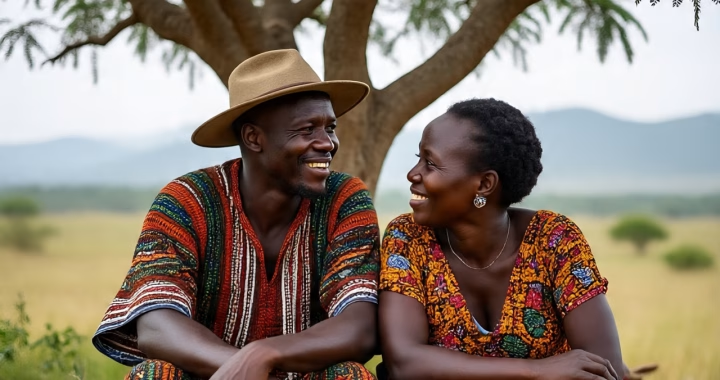
The village of Ochanya woke each morning to the song of roosters and the smell of woodsmoke. The air carried a rhythm that only those born into it could understand — the hush of dawn, the laughter of women at the stream, and the low hum of men heading to their farms.
Jerry was one of those men. Quiet, steady, known more for his calm eyes than his words. His father had taught him to till the red earth, and now he worked his small farm with the patience of one who knew that good things — yams, rain, love — all came only with time.
Lizzie, on the other hand, was light where Jerry was earth. She was often seen moving between the market stalls, a basket balanced neatly on her head, her laughter rising above the chatter like the sound of a flute. Everyone in the village knew her — not just because of her beauty, but because she had a way of making even silence feel warm.
They had known each other since childhood, though not closely. Jerry’s shyness and Lizzie’s spirited nature had always kept them at a polite distance. But that began to change one rainy season.
It started the day Jerry’s mother fell ill, and Lizzie began bringing herbs from her mother’s garden — a small kindness that grew into daily visits. They would sit by the doorway as the rain drummed on the roof, talking about small things — the stubbornness of goats, the sweetness of ripe mangoes, the way the village children chased dragonflies after the rain.
Days turned into weeks. When Lizzie didn’t come one afternoon, Jerry found himself glancing down the path more times than he cared to admit. When she finally appeared, smiling and wet from the rain, something in his chest tightened.
But he said nothing. Not yet.
The whole village seemed to see what he could not say. The old women teased Lizzie when she fetched water; the young men joked with Jerry at the farm. Yet the two of them continued their quiet rhythm — exchanging greetings, lingering glances, the brush of fingers when a basket changed hands.
And beneath the great udala tree that stood between their compounds, something gentle and certain began to grow.
Beneath the Udala Tree – Part 2
As the days went by, Jerry and lizzie saw each other more often.
Sometimes it was at the stream, where she washed clothes and he came to fetch water. Other times, it was at the market, where Jerry helped her lift her heavy basket of vegetables.
They always talked about small things — the weather, the crops, or how the village children played too close to the goats. But each talk made them feel closer, though neither wanted to say it out loud.
One evening, the sky turned red as the sun went down. Jerry was sitting outside his small hut, peeling cassava. Lizzie walked by, carrying firewood on her head.
“Jerry,” she called, smiling, “your mother said she wants more pepper soup tomorrow. Should I bring some pepper from my mother’s garden?”
Jerry smiled back. “Yes, please. She’ll like that.”
When she came the next morning, she stayed longer than usual. After checking on Jerry’s mother, she sat with him outside. They talked softly, their laughter mixing with the sounds of birds.
For the first time, Jerry found it hard to look away from her eyes. They were bright and full of life. Lizzie noticed his quietness and asked, “What are you thinking about?”
Jerry looked down at his hands. “Nothing,” he said — but inside, he knew it was not true. He was thinking about her.
Weeks passed. Rain came and went. Soon, everyone in the village could see that something was changing between them. When Igbe passed, Jerry’s face always lit up. When Jerry was away at the farm, Lizzieoften looked down the road, waiting for him to return.
But neither of them had spoken the words.
One evening, under the big udala tree, Lizzie stood waiting. The air was cool and full of crickets’ songs. Jerry came from the path, carrying a bundle of firewood.
“Lizzie,” he said softly. “You waited for me?”
She smiled. “I did. The moon is bright tonight. I just wanted to see it from here.”
They stood side by side in silence for a while. The night breeze moved through the leaves, and the moonlight touched their faces.
Finally, Jerry said, “Lizzie, I don’t know how to say this… but when you are not here, everything feels quiet.”
Lizzie turned to him, her smile gentle. “Then I will try not to be far away,” she said.
And under the udala tree, their friendship slowly became something deeper — not rushed, not loud, but steady and true.
Beneath the Udala Tree – Part 3
By the next planting season, everyone in the village had begun to talk.
Old women whispered at the stream, saying, “Those two are becoming one heart.”
The young men teased Jerry, and the girls smiled knowingly at Lizzie. But gossip in a small village spreads faster than harmattan fire — and not everyone was happy about it.
Lizzie’s father, Papa Ochanya, was a proud man. He had many farms and hoped his daughter would marry someone from a rich family. Jerry, though hardworking, was poor. His land was small, and his hut stood near the edge of the village.
One afternoon, when Lizzie returned from visiting John’s sick mother, her father called her inside.
“Lizzie,” he said, his deep voice firm, “I hear people are talking about you and that boy, Jerry. Is it true?”
Lizzie looked down, twisting her fingers. “Papa, Jerry is kind. He takes care of his mother and works hard. He is not just ‘that boy.’”
Her father frowned. “Kindness does not build a house, my daughter. Hard work is good, but hard work alone cannot feed a family. You deserve more.”
Lizzie stayed quiet, but her heart was heavy.
That evening, she went to the udala tree. Jerry was already there, waiting. The light from the setting sun painted the sky orange.
She told him everything. Jerry listened quietly, his eyes fixed on the ground. When she finished, he said softly, “Your father is right in his own way. I do not have much. But one day, I will.”
Lizzie looked at him and smiled, though her eyes were sad. “You already have enough for me, Jerry.”
He reached out and took her hand — just for a moment, before pulling away quickly. “Then I’ll keep working,” he said, his voice steady. “One day, your father will see what I see.”
From that day, Jerry worked harder than ever. He rose before sunrise, cleared more land, and planted new crops. When others rested, he kept going. He wanted to prove himself — not just to the village, but to the girl who waited for him beneath the udala tree.
Lizzie helped in her own quiet way. She brought food to his mother, carried water to the farm, and sometimes, when no one was looking, left a small calabash of palm wine by his doorstep.
The days passed slowly, but love — like a good harvest — takes time to grow.
Beneath the Udala Tree – Part 4
The next season came with trouble.
The rains were late, and the soil turned dry and cracked. Farmers stood in their fields, looking up at the sky, waiting for clouds that never came.
Jerry’s crops began to suffer. His yams were small, his cassava weak. Every day, he walked to his farm with hope, and every evening, he returned home with worry.
Still, he did not give up. “The land may fail me,” he said one night to his mother, “but I will not fail myself.”
Lizzie heard about his struggle. She came one afternoon, carrying a pot of soup and a bundle of roasted maize. Jerry was resting under a tree, sweat on his face, hands rough from work.
“You’ve done enough for one day,” she said softly, setting the food before him.
Jerry smiled weakly. “If I rest, who will make your father believe in me?”
Lizzie sat beside him. “My father sees only wealth,” she said. “But I see you. And I believe in you.”
Jerry looked at her, his heart full but his words few. “Thank you,” he whispered.
That week, a man from another village came — Okoh, tall and proud, with new clothes and two goats tied behind his horse. He went straight to Lizzie’s father’s house.
He brought gifts: palm oil, kolanuts, and a promise. “I want your daughter’s hand,” Okoh said. “I can take care of her.”
Papa Ochanya’s eyes brightened. “You speak well, my son. Let me talk to her.”
That night, he called Lizzie again. “This Okoh is a good man,” he said. “He has land, animals, and a big house. He can give you a good life. Forget this farmer, Jerry.”
Lizzie’s heart broke a little. “Papa,” she said, her voice shaking, “you cannot choose who my heart follows.”
Her father sighed. “Hearts don’t feed families, my child. Think well before you answer.”
The next day, Lizzie went to see Jerry. She found him still in his field, his hoe resting beside him. The sun was high, but he didn’t stop working.
She told him everything — about Okoh, the gifts, and her father’s words.
Jerry stayed quiet for a long time. Then he said, “If your father wants the best for you, I cannot blame him. But I will not stop trying. The earth will bless me one day — and when it does, I will come for you.”
Lizzie looked at him, eyes full of tears. “Even if the whole village turns against us, I will still wait under the udala tree.”
Beneath the Udala Tree – Part 5
The dry season finally passed.
When te rains came again, it was as if the land itself had taken pity on the people. The farms turned green, and hope slowly returned to the hearts of the villagers.
Jerry worked harder than ever. Each morning before sunrise, he was already on his farm, planting, weeding, and singing quietly to himself. The ground that had once failed him now began to answer his effort. His yams grew big and strong; his cassava stood tall.
By harvest time, Jerry’s field was the talk of the village. People said, “That young man’s sweat has spoken for him.” Even Papa Ochanya heard it.
One afternoon, John carried his harvest to the market. He sold enough to buy two goats, a small piece of land, and a fine wrapper for his mother. The rest, he saved.
When he returned home, he sat quietly under the udala tree. The air was cool, and the leaves whispered above him. Soon, Lizzie appeared, carrying a calabash of fresh palm wine.
“Your farm is the pride of the market,” she said with a smile. “Even my father heard people talking.”
Jerry laughed softly. “Then maybe the land has finally accepted me.”
They sat together, sharing the palm wine as the evening sun painted the world gold. For a moment, everything felt peaceful — like the earth itself was blessing them.
A few days later, Jerry gathered courage and went to Papa Ochanya’s compound. The old man was sitting outside, chewing a stick of sugarcane.
Jerry greeted him respectfully. “Good evening, sir.”
Papa Ochanya nodded. “Jerry, I’ve heard about your harvest. You have done well.”
Jerry took a deep breath. “Sir, I came to speak about your daughter. I have worked hard this past year, not just for myself, but to prove that I can care for her. I do not have much yet, but I am ready to keep trying.”
The old man looked at him for a long time. Then he sighed. “You remind me of myself when I was young,” he said slowly. “A man who loves the land — and a woman — with the same quiet strength.”
He paused, then added, “If Lizzie truly wants this, you have my blessing.”
Jerry’s heart almost leapt from his chest. He bowed deeply, his voice trembling. “Thank you, sir.”
That evening, as the sun went down, he ran to the udala tree. Igbe was already there, waiting as always.
When he told her what her father had said, she covered her face with her hands and laughed — a soft, happy sound that seemed to fill the air.
Jerry took her hands in his. “It seems the land has finally blessed us both,” he said.
And under the same udala tree where their friendship began, their love found its home — simple, true, and lasting like the roots beneath their feet.
Epilogue – Beneath the Udala Tree
Years passed, and life in the village moved with its quiet rhythm.
The udala tree still stood tall, its branches wide and full, watching over the land as seasons came and went. Beneath it, two children often played — a boy and a girl, their laughter echoing through the fields.
From a distance, Jerry and Lizzie sat watching them. The years had changed them — a few lines on their faces, a touch of silver in Jerry’s hair — but their smiles were the same.
Jerry’s farm had grown larger. He now helped other farmers, teaching them how to care for the soil and wait with patience. Lizzie’s small trade had also blossomed; her pepper and palm oil were known even in nearby villages.
Sometimes, when the evening breeze blew, Lizzie would say, “Do you remember, Jerry, when you said the land would bless you one day?”
Jerry would smile, looking at her and the children playing nearby. “I remember,” he’d say softly. “But I did not know the blessing would be this full.”
Every year, during the harvest, the whole family would gather under the udala tree. They would spread mats, share food, and tell stories of how it all began — of rain and drought, of hope and waiting, of love that grew like roots in red earth.
And when the moon rose high and the night grew quiet, Jerry would sometimes look up at the wide sky and whisper a prayer of thanks — not for riches, but for the simple joy of a life built with love, patience, and faith.
Beneath the udala tree, their story lived on — not in words, but in the steady heartbeat of two souls that had learned to grow together.